Not really. It’s a way of saying there comes a time each winter when we get so fed up with the gloomy weather that we rewatch The Expanse. If you are a space sci-fi geek like my wife and I and somehow you haven’t encountered the series, I can heartily recommend it.
I have now ridden almost 150 miles on the new Estarli e28.X. I realise there are people who probably cover that distance weekly, but I am retired and unashamedly a largely fair weather cyclist, so my outings to date have not been all that frequent: mostly short hops to shop or café.
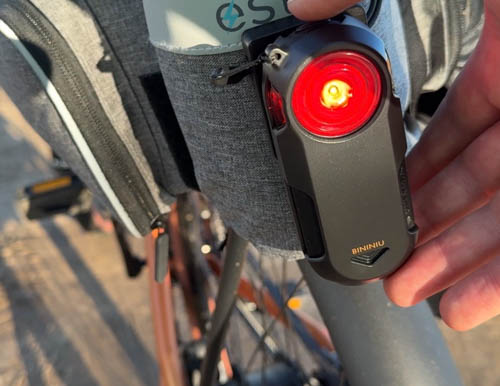
I did make a 19-mile (28km) loop out to Abberton Reservoir south of here last week, mostly on quiet country roads where the warnings flagged up on my Garmin Edge sat nav by the Martian stealth tech Varia RTL515 rear-facing radar were very useful. I won’t say much more about the Varia because it has been around for some years now and is well reviewed elsewhere, but I am definitely impressed by how well it works.
One more gadget to keep charged! Using, wherever possible, the solar-derived electricity from our rooftop panels that I talked about in another recent video, which might form the subject of a whole other article. They are saving us lots of money – albeit not in January, for obvious reasons of climate and latitude here in the UK.
MUSCLE MASS
Following the traditional dietary over-indulgence of Thanksgiving (my wife is American) then Christmas a month later, I am now making a determined effort to eat, drink and exercise better. The e-bike obviously plays into the latter ambition, and I think it is definitely paying off too.
It is worth remembering why I got it in the first place, which was as part of an injury rehabilitation; I wrote about this in a previous discussion of pedalling cadence: E28.X cadence cadenza. We call them e-bikes but they are technically, legally, Electrically Assisted Pedal Cycles (EAPCs), meaning they have a “maximum continuous rated power” not exceeding 250 watts that cannot propel the vehicle when it is travelling at more than 15.5 mph (25 km/h).
Incidentally – this confuses people new to the concept – the regulations do not mean the bike cannot go faster than that. Ride hard enough down a steep enough hill and I dread to think what velocity you might attain. It means the motor is not allowed to add propulsion above that speed limit: you are on your own. One of the things I like about the e28.X is that you sail through the limit without particularly noticing that you are no longer getting any motor input.
Assistance with pedalling was exactly what I needed as I rebuilt leg muscle capability. The Estarli provides five levels of power, in response to a torque sensor in the pedal crank: the harder you press the more it responds. In practice, locally, I ride almost everywhere in Level 1 (or nothing at all, on the flat) or 2.
Only occasionally does a hill call for added impetus from the rear hub drive: the maximum incline on my recent Abberton loop, for example, was 12 or 13% (depending on which app you believe) but only briefly. This was on Bounstead Road going north up from the Roman River, for those who know the area. I recall that I was using Level 3; I think I have used 5 only two or three times in the three months that I have owned the bike.
This is something that can catch out newcomers to e-bikes. The sudden surge of power, if applied too hard on, say, a sharp bit of manoeuvring at low speed, can send you off at a tangent. It is a thing you learn to manage.
As my strength improves I would hope to depend even less on the motor, unless I am feeling really lazy. This is important for general fitness – but is given added significance as we age, when muscle mass naturally declines.
External links: